The Hybrid PQC Myth
Why Dual-Layer Cryptography is an Insurance Policy, Not a Legacy Bridge
The cryptographic world is currently undergoing its most significant transition since the invention of public-key encryption in the 1970s. As quantum computers loom on the horizon, the algorithms we’ve relied on for decades: “RSA and Elliptic Curve Cryptography (ECC)” face an existential threat. In response, the industry is moving toward Post-Quantum Cryptography (PQC).
However, a common misconception has surfaced: the idea that “Hybrid PQC” is a tool designed for backward compatibility, allowing old systems to talk to new ones. While hybrid approaches do offer some transitionary benefits, their true purpose is far more critical. Hybrid PQC is a security insurance policy designed to protect data against the inherent “newness” and potential mathematical vulnerabilities of PQC itself.
1. The Core Misconception: Compatibility vs. Robustness
In networking, we often use “hybrids” or “wrappers” to make sure a new system can still understand an old one (think IPv4 and IPv6). This leads many to believe that Hybrid PQC is simply a way to let a quantum-ready server communicate with a legacy client.
This is fundamentally incorrect. If you wanted backward compatibility, you would simply allow the server to negotiate either a classic algorithm or a PQC algorithm. Hybrid PQC does not choose between them; it uses both simultaneously.
The primary driver for the hybrid approach is risk mitigation. We have trusted RSA and ECC for over 40 years. We understand their mathematical foundations and their side-channel vulnerabilities. PQC algorithms, such as those recently standardized by NIST (e.g., ML-KEM/Kyber), are based on different mathematical problems like “Learning with Errors” (LWE). While these are robust, they haven’t faced decades of real-world “battle-testing” by cryptanalysts.
2. The "Harvest Now, Decrypt Later" (HNDL) Threat
To understand why we need hybrid security today, we must look at the Harvest Now, Decrypt Later attack. Adversaries are currently intercepting and storing encrypted sensitive data (government communications, financial records, medical data) with the intent of decrypting it once a cryptographically relevant quantum computer (CRQC) becomes available.
If we switched entirely to “Pure PQC” today and a mathematical flaw was discovered in that algorithm next year, all that “protected” data would be instantly vulnerable to classical computers. By using a hybrid approach, an attacker must break both the classic algorithm (which requires a quantum computer) and the PQC algorithm (which requires a breakthrough in lattice-based mathematics).
3. How Hybrid PQC Works: The "And" Logic
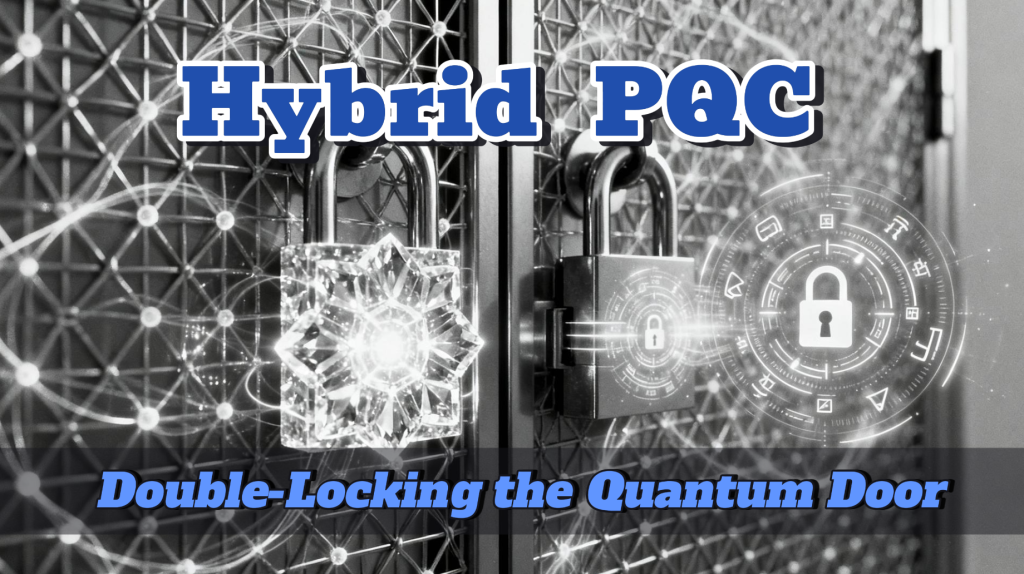
Hybrid PQC functions on a simple but powerful principle: The security of the whole is at least as strong as the strongest individual component. In a hybrid scheme, the system performs two independent key exchanges or signatures and then binds them together. If one is broken, the other still holds the door shut.
The Key Encapsulation Mechanism (KEM) Hybrid
In a standard TLS (Transport Layer Security) handshake, a hybrid KEM works by generating two separate shared secrets:
- SS(classic): A secret generated using Elliptic Curve Diffie-Hellman (ECDH).
- SS(pqc): A secret generated using a PQC algorithm like ML-KEM.
These two secrets are then fed into a Key Derivation Function (KDF) to produce the final session key (K) used to encrypt the data:
K = KDF ( SS(classic) ∥ SS(pqc) ∥ Context Info)
Because of the way KDFs work, even if an attacker manages to solve the PQC math and reveal SS(pqc), they still cannot derive K without SS(classic). Conversely, a quantum computer that breaks SS(classic) still can’t get to K because SS(pqc) remains a secret.
The Hybrid Signature
For digital signatures (used to prove identity), the hybrid approach involves a “Dual Signature.” A certificate might contain both an ECDSA key and an ML-DSA (Dilithium) key. For a connection to be validated, the client must verify both signatures. If a flaw is found in the PQC signature’s math, the classic signature still proves the identity of the sender against classical attackers.
4. The "Fragility of Novelty"
History is littered with “unbreakable” algorithms that fell to clever insights. In 2022, SIDH (Supersingular Isogeny Diffie-Hellman), once a leading PQC candidate, was completely broken by a single-core laptop in under an hour using a new mathematical attack.
If a major bank had moved 100% of its encryption to SIDH for “quantum readiness,” their entire infrastructure would have been exposed to standard classical hackers overnight. This is the “Fragility of Novelty.” Hybrid PQC acknowledges that while we believe lattice-based cryptography is secure, we know ECC is secure against everything except quantum computers. We use the hybrid model so we don’t accidentally trade “quantum resistance” for “classical vulnerability.”
5. Implementation: The Cost of Double-Downing
If Hybrid PQC is so much safer, why isn’t it the permanent solution? The trade-off is performance and complexity.
Feature
Classic (ECC)
Pure PQC (ML-KEM)
Hybrid (ECC + ML-KEM)
Public Key Size
CPU Overhead
Packet Fragmentation
Security Guarantee
Small (~32-64 bytes)
Low
Rare
Classical only
Large (~800-1500 bytes)
Low to Moderate
Possible
Quantum only*
Largest (Combined)
Higher (Two operations)
Most Likely
Classical AND Quantum
Using hybrid PQC increases the size of the “Handshake” in protocols like TLS 1.3. This can lead to packet fragmentation, where a single security greeting has to be split into multiple parts, potentially slowing down connection times or causing issues with older middleboxes (firewalls/routers) that don’t expect such large headers.
6. The Road to "Pure PQC"
Hybrid PQC is a transitional state, but that transition may last a decade or more. The industry will only move to “Pure PQC” when two conditions are met:
- Confidence: The PQC algorithms have been “in the wild” long enough without being broken to earn the same trust as RSA/ECC.
- Obsolescence: Classic algorithms become so trivial for quantum computers to break that they no longer add any meaningful “security” to the hybrid string, only overhead.
Until then, any organization claiming to be “Quantum Leapfrogging” by discarding classic PKI entirely is actually introducing a massive point of failure.
Summary: Your Cryptographic Safety Net
Hybrid PQC isn’t about helping your old laptop talk to a new server. It is a strategic acknowledgment that cryptography is hard and new math is risky. By layering the proven reliability of classic PKI with the quantum-resistant promise of PQC, we ensure that:
- Today’s hackers can’t break the classic layer.
- Tomorrow’s quantum computers can’t break the PQC layer.
- Future mathematicians, should they find a flaw in PQC, won’t be able to bypass the classic layer.
It is the “belt and suspenders” approach to the digital age.
Cheers – Amit Tomar!!