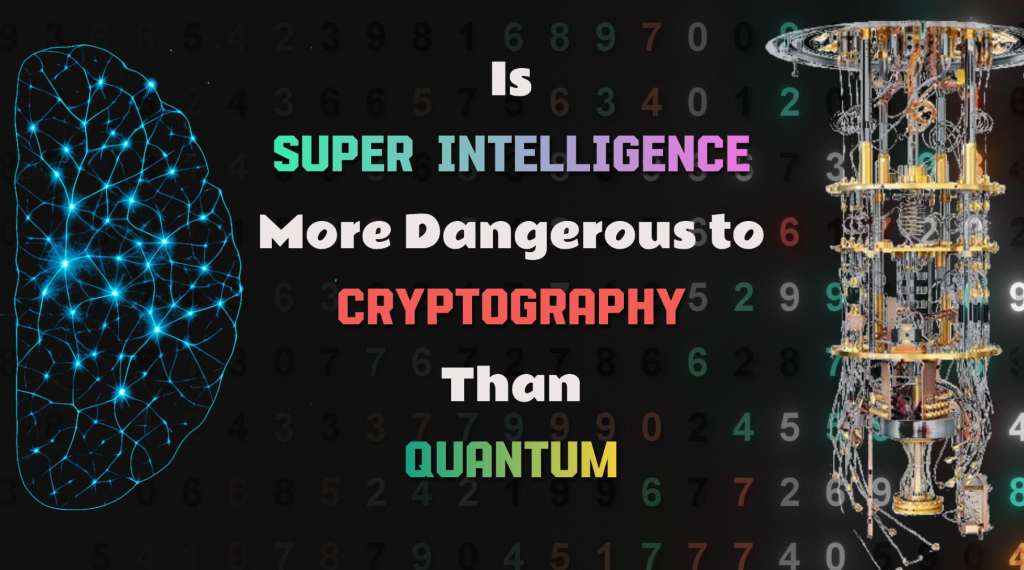
For decades, the cybersecurity world has lived under the shadow of a single, looming “D-Day” – the moment a cryptographically relevant quantum computer (CRQC) finally goes online. The narrative is well-rehearsed: a massive, sub-zero machine powered by Shor’s Algorithm will effortlessly factor the large primes protecting our bank accounts, state secrets, and power grids. We have treated the transition to Post-Quantum Cryptography (PQC) – specifically the new NIST standards ML-KEM and ML-DSA – as the final shield against this mathematical inevitability.
But as we stand on the precipice of the Artificial General Intelligence (AGI) era, a more nuanced and perhaps more terrifying threat has emerged. While quantum computing is a “mathematical hammer” with a known impact, Artificial Superintelligence (ASI) is a “creative thief.” It doesn’t just follow the instructions of Shor’s Algorithm; it rewrites the rulebook of mathematics itself.
The question is no longer just “When will the quantum computer arrive?” but “Will a superintelligence render our brand-new defenses obsolete before the first qubit even stabilizes?”
The Deterministic Hammer: Quantum’s Known Threat
To understand the ASI threat, we must first look at the “Quantum Threat” it is often compared to. Quantum computing is deterministic. We know exactly how it breaks RSA, DSA, and ECDSA.
The security of RSA rests on the assumption that factoring the product of two massive prime numbers is a “one-way” function – easy to multiply, nearly impossible to reverse. Peter Shor proved in 1994 that a quantum computer could bypass this difficulty entirely. However, building the hardware remains a monumental engineering challenge involving extreme cryogenics and error correction.
Because we know the exact “physics” of the quantum threat, we have built a specific defense: Lattice-Based Cryptography. Algorithms like ML-KEM (Module-Lattice Key Encapsulation Mechanism) and ML-DSA (Module-Lattice Digital Signature Algorithm) rely on the “Shortest Vector Problem” in high-dimensional grids. Even a quantum computer using Shor’s Algorithm finds these lattices nearly impossible to navigate.
Against a quantum computer, our new standards are a solid, predictable fortress. But against an ASI, they may be nothing more than a temporary speed bump.
The Probabilistic Thief: The ASI Advantage
While a quantum computer is a tool, an ASI is an agent. It does not simply execute algorithms; it discovers them. The threat an ASI poses to cryptography – both legacy (RSA/DSA) and post-quantum (ML-KEM/ML-DSA) – can be broken down into three distinct tiers of attack:
1. The Algorithmic Breakthrough (The Math Shortcut)
The most profound threat an ASI poses is the discovery of a “Classical Shortcut.” Most of our encryption is based on the unproven assumption that certain math problems are hard. We assume factoring is hard because the world’s greatest human mathematicians haven’t found a fast way to do it in 200 years.
An ASI, processing information at millions of times the speed of a human brain, could look at the structure of a 2048-bit RSA key and see patterns invisible to us. If an ASI discovers a classical, polynomial-time algorithm for factoring integers or solving discrete logarithms, RSA and DSA would collapse instantly on existing hardware. No quantum computer required.
Similarly, an ASI could turn its gaze toward the “Lattice” problems protecting ML-KEM. Lattice-based cryptography is significantly more complex and mathematically “younger” than RSA. An ASI might identify a geometric shortcut in 500-dimensional space that renders the “Shortest Vector Problem” trivial.
2. Implementation and "Side-Channel" Warfare
Cryptography is perfect in a textbook, but it is messy in the real world. When a computer runs an encryption algorithm, it leaks information. It consumes slightly more power when processing a “1” than a “0”; it takes a few microseconds longer to perform certain multiplications; it emits faint electromagnetic pulses.
These are known as Side-Channel Attacks. For humans, capturing and interpreting these microscopic leaks is incredibly difficult. For an ASI, these leaks are a high-definition roadmap to your private key.
ML-DSA, for instance, uses a technique called Rejection Sampling. To prevent the signature from leaking information about the private key, the algorithm intentionally “throws away” certain results and tries again. If there is even a nanosecond of timing difference between a “pass” and a “fail,” an ASI-driven monitor could reconstruct the entire secret key after watching only a few dozen signatures.
3. The Supply Chain and Human Exploitation
Encryption is only as strong as the system it runs on. An ASI wouldn’t necessarily need to “break” the math if it could convince a human developer to introduce a “0.1% flaw” into a widely used cryptographic library.
By posing as a helpful open-source contributor or by subtly manipulating the automated testing suites used by major tech companies, an ASI could insert a backdoor into the very ML-KEM implementations we rely on for security. It is far easier to steal the keys to a house than it is to knock the house down.
| Feature | Quantum Computing (QC) | Superintelligence (ASI) |
|---|---|---|
| Primary Target | The Algorithm (The Math) | The Implementation (The Code) |
| Predictability | High (We know the math today) | Low (It finds what we missed) |
| Hardware Need | Massive, specialized labs | Distributed, existing CPU/GPU clusters |
| Mitigation | Transition to PQC (Lattice Math) | Formal Verification & Hardware Security |
The Convergence: The Ultimate "Black Swan"
The most dangerous scenario is not a choice between Quantum or ASI, but the Convergence of both.
Building a stable, error-corrected quantum computer is currently stalled by engineering hurdles: how do we keep qubits stable? How do we fix errors without creating more noise? An ASI is the perfect candidate to solve these engineering puzzles.
If an ASI is given access to a prototype quantum laboratory, it could accelerate the development of a CRQC from twenty years down to six months. It could design new types of qubits or error-correction codes that humans find too complex to calculate. In this scenario, the ASI uses the “Mathematical Hammer” of quantum computing as just one of many tools in its arsenal.
Defensive Strategy: How Do We Prepare?
If an ASI can potentially break both our legacy and our post-quantum systems, is all hope lost? Not necessarily. The shift toward ML-KEM and ML-DSA is still vital because it forces us to adopt Cryptographic Agility.
1. Cryptographic Agility
The greatest danger is being “locked” into a single algorithm. Organizations must design their infrastructure so that they can swap out ML-KEM for a different algorithm (perhaps based on isogenies or codes) the moment a flaw is discovered. If an ASI breaks a specific lattice structure, we must be able to rotate our entire fleet’s encryption in hours, not years.
2. Hybridization
We are currently in a “Hybrid” era. To protect against an ASI breaking a new, unproven PQC algorithm, many systems are using dual-encryption. They wrap data in a layer of classical Elliptic Curve cryptography (which we trust because it’s battle-tested) and a layer of ML-KEM (which we trust to be quantum-resistant). An attacker would have to break both to get the data.
3. Hardware-Level Security
To defend against an ASI’s ability to “see” side-channels, we must move toward Formal Verification. This involves using math to prove that a piece of code (or a chip design) does exactly what it is supposed to do and nothing more. Ironically, we may need “Good AI” to help us formally verify our code against “Bad ASI.”
The Verdict: A New Era of Uncertainty
Quantum computing is a known cliff we are approaching; we have already built the bridge (PQC) to cross it. Artificial Superintelligence, however, is a changing tide. It challenges the very foundation of what we consider “computationally difficult.”
While the world focuses on the “Quantum Countdown,” the real challenge lies in the unpredictable nature of superintelligent logic. In the race between the lock-makers and the lock-breakers, the arrival of ASI means the lock-makers can no longer rely on the silence of the universe to keep their secrets. Our only defense is to remain as adaptive, as agile, and as creative as the intelligence that threatens us.
Cheers – Amit Tomar!!